Osprey Framework Documentation#
An agentic interface for safety-critical control systems.
New architecture (April 2026)
Osprey has transitioned from its legacy LangGraph orchestrator to a coding-agent harness with MCP servers and hook-based approval. If you’re upgrading from a previous version, see Guided Project Setup. The last LangGraph-era release is archived at v0.11.5 docs (also reachable via the version picker in the top-right).
The Osprey Framework is an agentic interface and harness for scientific facilities managing complex technical infrastructure — particle accelerators, fusion experiments, beamlines, and large telescopes. It wraps a coding agent in an operator-facing safety policy, a hook-based approval chain, and an MCP-server multiplexer, so the agent layer, the underlying LLM, and the compute backend are each replaceable without changing what the operator sees. The current reference implementation is a browser-based operator workstation; other surfaces (control-room consoles, chat clients, headless services) are possible.
Osprey addresses control-specific challenges: semantic addressing across large channel namespaces, protocol-agnostic integration with control stacks (EPICS and Mock ship in-tree; LabVIEW, Tango, and other stacks are supported via custom connectors), intelligent logbook search across facility electronic logbooks, and mandatory human oversight for safety-critical operations.
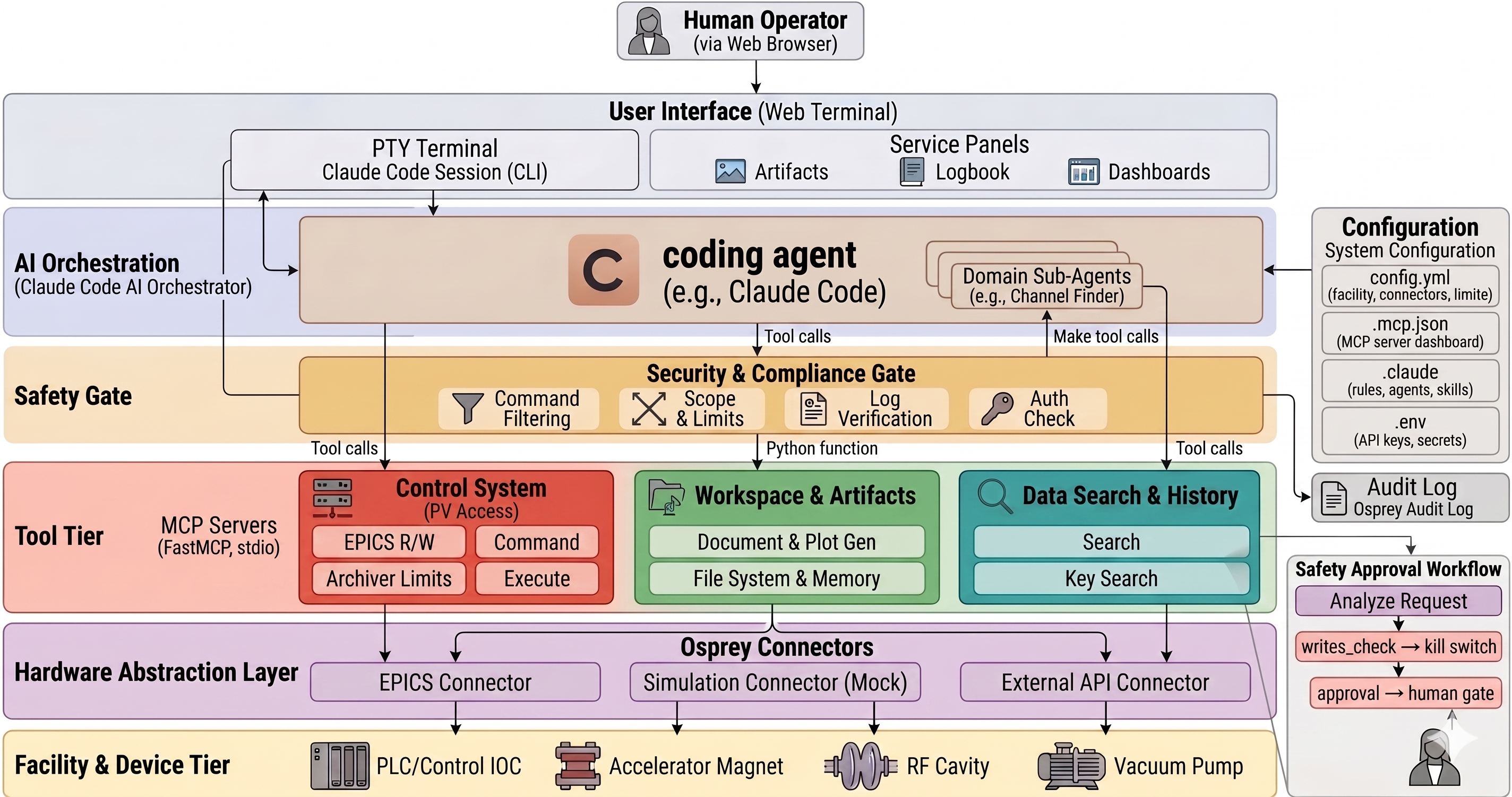
Osprey system architecture (for a detailed view, see Architecture).#
Documentation Structure#
Install Osprey, create your first project, and deploy a control assistant with a coding agent and MCP servers.
Core concepts: agentic orchestration, MCP servers, connectors, human-in-the-loop safety, and the runtime API.
Task-oriented recipes for adding connectors, configuring providers, deploying projects, and customising MCP servers.
Development setup, coding standards, testing guidelines, and the contribution workflow.
Proven in Production#
Osprey is deployed at Lawrence Berkeley National Laboratory’s Advanced Light Source, managing tens of thousands of control channels across accelerator operations.
Citation
If you use the Osprey Framework in your research or projects, please cite our paper:
@article{10.1063/5.0306302,
      author = {Hellert, Thorsten and Montenegro, João and Sulc, Antonin},
      title = {Osprey: Production-ready agentic AI for safety-critical control systems},
      journal = {APL Machine Learning},
      volume = {4},
      number = {1},
      pages = {016103},
      year = {2026},
      month = {02},
      doi = {10.1063/5.0306302},
      url = {https://doi.org/10.1063/5.0306302},
}