The Search Sidecar (qmd)#
qmd is a search service that runs as a sidecar: its own container,
deployed beside the services that query it. It indexes a markdown corpus
(a directory tree of markdown documents) and answers hybrid
keyword-plus-semantic queries over HTTP. A deployment runs one qmd sidecar
per corpus. Two parts of OSPREY use them:
ARIEL’s logbook mirror — the
hybridsearch mode and thehybrid_searchMCP tool;the facility-knowledge (OKF) bundle — its panel and its MCP
searchtool.
qmd can fan one query out into keyword and vector sub-queries, merge them into a
bounded candidate pool, and optionally re-score that pool with a small language
model before returning hits. That is ARIEL’s default qmd hybrid strategy.
The optional rrf strategy instead asks qmd only for lexical BM25 (the
standard keyword-relevance ranking) results. It gets the dense ranking from
ARIEL’s configured PostgreSQL semantic search, and merges the two lists itself
with equal-weight RRF (reciprocal-rank fusion, which scores a hit by its rank
in each list). This diagram shows qmd’s combined-query path:
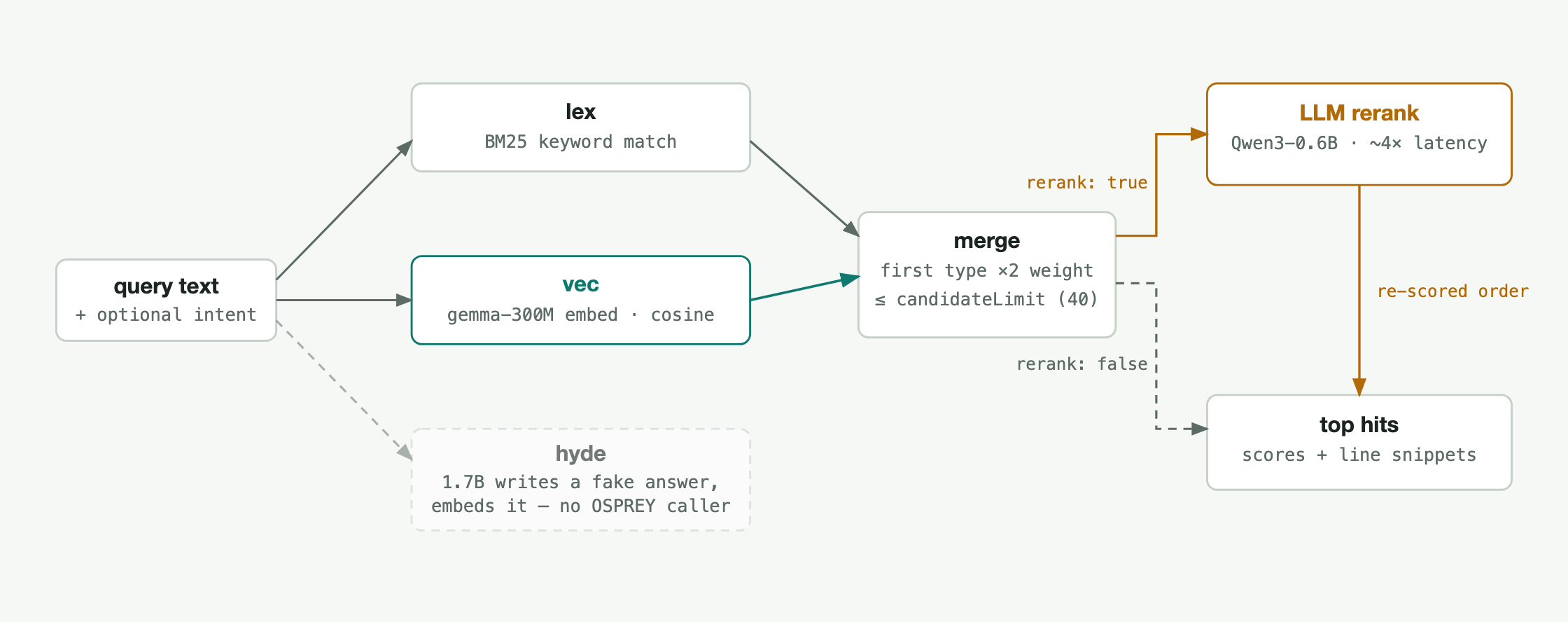
Inside one qmd query. rerank and candidate_limit are the two knobs
the configuration below exposes.#
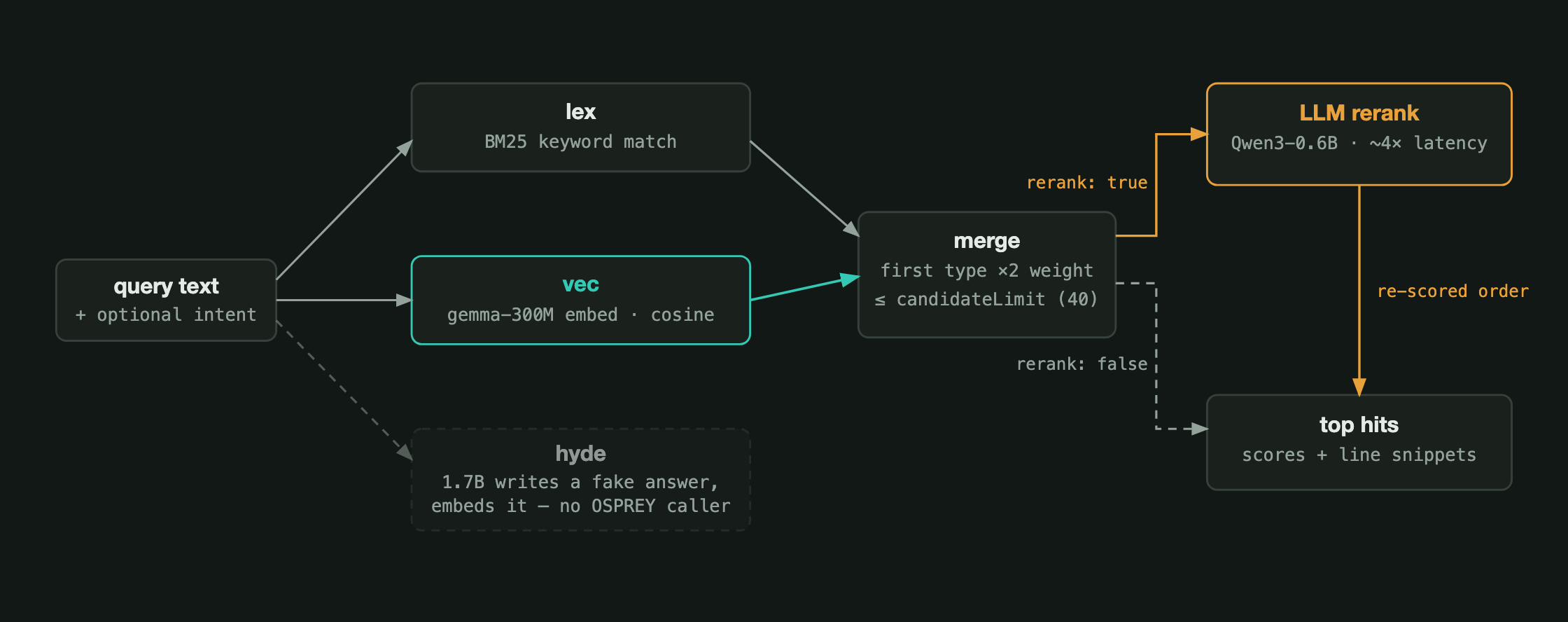
Inside one qmd query. rerank and candidate_limit are the two knobs
the configuration below exposes.#
The greyed hyde branch ships in the image but nothing in OSPREY calls it.
It is entirely self-contained — its language models are baked into the image,
so unlike the semantic search mode it needs no Ollama on the host — and
the demo template deploys it by
default, together with its two ARIEL consumers (the qmd_export
enhancement module and the hybrid search mode). The OKF bundle needs only
facility_knowledge.bundle_path, which it already has.
The image is built locally, never pulled. osprey build renders
./services/qmd; osprey up builds the image on first run and tags it
<project>-qmd:local, project-prefixed so two OSPREY projects on one host
cannot race for one tag. The baked-in models make that first build about
2.1 GB of download; later runs reuse the local tag. A host with no route to
the internet can supply the models itself — see Build the image without internet access.
Configuration#
services:
  qmd:
    path: ./services/qmd
    port: 10060     # host port clients talk to
    interval: 30    # fallback corpus-sweep period, seconds
    first_index_grace: 3600   # seconds the health check waits out the first build

deployed_services:
  - qmd
Those four keys are the whole schema for a host that can reach the internet;
models_dir covers one that cannot (see Build the image without internet
access), and corpora adds corpora of your own (see Add a corpus).
Notably there is no ``bind_address`` here — see Where the sidecar
listens below.
interval is a ceiling on staleness, not the usual lag: a corpus writer
touches a .qmd-touch marker file and the sidecar re-indexes within one poll.
The interval only catches writers that forgot to touch it. Raise it on a large
corpus — a sweep that finds nothing changed still costs about 12.5 seconds at
135,000 documents, so the 30-second default leaves the loop busy roughly 42% of
the time discovering nothing.
Turn the sidecar off#
Neither consumer strictly needs the sidecar — OKF search falls back to substring matching and hybrid logbook search reports an outage — so a deployment that does not want a second index can switch it off. That takes three edits, not one, because any subset leaves either a container nobody queries or a search mode with nothing to search:
Comment out the
qmd:entry underservices:.Comment out the
- qmdline underdeployed_services:.Disable both
ariel.search_modules.hybridandariel.enhancement_modules.qmd_export.
Build the image without internet access#
Downloading the three model files is the one step of the image build that
reaches the internet, so on a host without egress the build stalls there.
models_dir names a host directory that already holds those three files:
services:
  qmd:
    path: ./services/qmd
    models_dir: /opt/qmd-models   # absolute path, three GGUF files
One key does both halves of the job — the build skips the download, and the directory is bind-mounted read-only where the image expects to load models from. Setting only one half would leave the container with no models at all, which is why it is a single key rather than two.
Skipping the download does not skip verification, it moves it: the checksums travel with the image, and the entrypoint checks all three files on every start. A missing or misnamed file is refused before compose runs, by a deploy-time check that looks for the three expected filenames — rather than surfacing an hour later as a container that never became healthy.
One sidecar per corpus#
Every corpus gets its own sidecar: its own container, its own index and its own port. A small corpus therefore never shares a vector scan, an update sweep or a rebuild with a large one, and a search restricted to one corpus returns that corpus’s nearest neighbours no matter how large the others grow. Two corpora are derived from configuration you already have:
Corpus |
Port |
Source |
Present when |
|---|---|---|---|
|
|
|
the bundle path is set |
|
|
|
the export is enabled and names a path |
Embedding is most of an index build, so the ariel sidecar computes vectors
only when ARIEL’s hybrid search queries them: with strategy: rrf, or with
hybrid search off, it builds the keyword index alone. okf always embeds.
Each sidecar is the compose service qmd-<corpus> (qmd-okf,
qmd-ariel, …), all running the one image. Its corpus is bind-mounted
read-only at /corpus/<corpus> and indexed as a collection of the same
name, which is the name clients query it by. Read-only is deliberate: the
sidecar indexes the tree, and everything that writes it lives outside the
container.
Each index lives in its own named volume, qmd_index_<corpus>, rather than a
bind mount. It is derived data the sidecar owns end to end, it is large, and
rebuilding it costs a full index build — long on a large corpus — which is
precisely why it must survive a container recreate. The service’s health check
waits out that build for the same reason: the sidecar refuses to open its port
until the index is built and provably non-empty, so until then a container that
is working correctly would be reported unhealthy. first_index_grace is how
long it waits, in seconds, and it defaults to an hour. Scale it with your
largest corpus: shorter than the build and the first boot is reported as a
failure.
Embedding a large corpus takes several passes. qmd embed stops after a fixed
session (30 minutes) and still reports success, so the sidecar repeats it until
no document is left without vectors, or until a pass embeds nothing — some
chunks fail on every retry. osprey health shows each sidecar as one row of
the qmd category, with a warning when documents still have no vectors and
are found by keyword search only.
Add a corpus#
corpora adds corpora beyond those two, each served by its own sidecar at
port + 2 onwards, in list order; the family has room for eight.
services:
  qmd:
    path: ./services/qmd
    corpora:
      - name: textbooks
        source: /data/library/textbooks    # a markdown tree, indexed here
      - name: papers
        index: prebuilt
        index_dir: /data/qmd/papers-index  # built elsewhere, served here
A corpus’s index comes to exist in one of two ways:
managed(the default)The sidecar indexes
source, a directory of markdown, and keeps the index current itself, exactly as it does forokfandariel.embed: false, for a corpus searched by keyword alone, skips the embedding pass; a vector search on that corpus returns nothing. Turningembedoff rebuilds the keyword index once, with the search port closed meanwhile; turning it back on embeds the pending documents, no rebuild.prebuiltThe index was built elsewhere — typically on a GPU host, where embedding runs several times faster than on a CPU — and
index_diris the directory holding it (its.qmd/index.sqliteand.qmd/index.yml, which is the state directory of the sidecar that built it). The sidecar mounts that directory as its state directory and only serves it: it never re-indexes. It refuses to start if the index was built with a different embedder from the one its image queries with, or holds no collection named after the corpus.
A relative source or index_dir resolves against the deployment repo.
osprey up refuses a declared corpus whose path holds nothing to index or
serve, before anything is built.
Disk footprint#
Measured against a real 134,996-entry logbook:
Component |
Size |
|---|---|
Markdown mirror (logical) |
41 MB |
Markdown mirror (allocated on disk) |
553 MB |
qmd index |
695 MB |
Total per 135,000 entries |
1.25 GB (~925 MB per 100,000) |
The gap between logical and allocated size is the point to budget for: the mirror is one small file per entry, so it is dominated by filesystem block overhead rather than by content. Chunking is close to 1:1 for logbook micro-documents (2,000 documents produced 2,001 chunks), so the index grows with entry count rather than with entry length.
Memory footprint#
The image carries a small set of patches on top of the pinned qmd release
(patches/README.md in the service template lists them and the upstream
changes they mirror). One of them makes the daemon hold every stored vector in
RAM and score a query with an exact scan instead of a sqlite-vec lookup, which is
what keeps a search well under a second on a large index. The cost is memory:
4 bytes per dimension per chunk, so about 3 KiB per chunk at the embedder’s 768
dimensions. Each corpus runs its own sidecar, so budget it per corpus:
Index |
Resident vectors |
|---|---|
135,000 logbook entries (~135,000 chunks) |
~0.4 GB |
62,797 papers (791,230 chunks) |
2.3 GB |
The matrix loads in the background after the daemon starts (about 13 s for the
papers index); until it is ready, and after any change to the index until it
reloads, searches go to sqlite-vec, so a result is never served from stale
vectors. QMD_VEC_SCAN=vec0 turns the in-memory scan off and searches
sqlite-vec directly, as the plain release does: export it on the host and name
it under services.qmd.env to hand it to every qmd sidecar.
services:
  qmd:
    env: [QMD_VEC_SCAN]
Where the sidecar listens#
The sidecars publish 10060–10069, the qmd band of the deployment’s
port layout (Ports), one port per corpus as listed in One
sidecar per corpus; the block’s port key moves the whole band if you need
that. qmd’s own daemon runs on 8181 on the container’s internal loopback
and is fronted by a small forwarder. That split is
not cosmetic: qmd hardcodes a loopback-only bind with no option to change it,
which makes it unreachable from any other container. Only the forwarder owns a
routable port.
Warning
The sidecar has no authentication. No token, no TLS, no per-caller identity — it answers any request that reaches it, over the whole indexed corpus. That is safe exactly as long as only this host can reach it.
This is why bind_address is not a services.qmd key. Like every
other service, the sidecar publishes on the project-wide
deployment.bind_address (default 127.0.0.1), so a deployment cannot
put an unauthenticated search endpoint on an interface the rest of the stack
is not already on. Moving that one key off loopback moves this service too.
How clients reach it#
A client on the host, such as a web terminal, dials the published port at the
deployment.bind_address. A container on the compose network cannot: the
host’s loopback is its own. So the ARIEL sync daemon and the dispatch workers
are each handed one OSPREY_QMD_<CORPUS>_URL per sidecar, naming it by its
compose service name (http://qmd-ariel:10061), and dial that instead. Under
network: host those services dial the published port like any host client.
osprey health probes through the same rule, so run inside a container it
reports on the address that container’s clients use, and an ARIEL search that
falls back to picture matches names the sidecar URL it could not reach.
osprey build refuses a sidecar moved to the host network while one of its
consumers stays on the compose network, since the name it would dial does not
exist there.
See also
- Container Deployment
The container-deployment mechanics shared by every service — the build/up lifecycle, image overrides, network binding, and the
.envchain.